

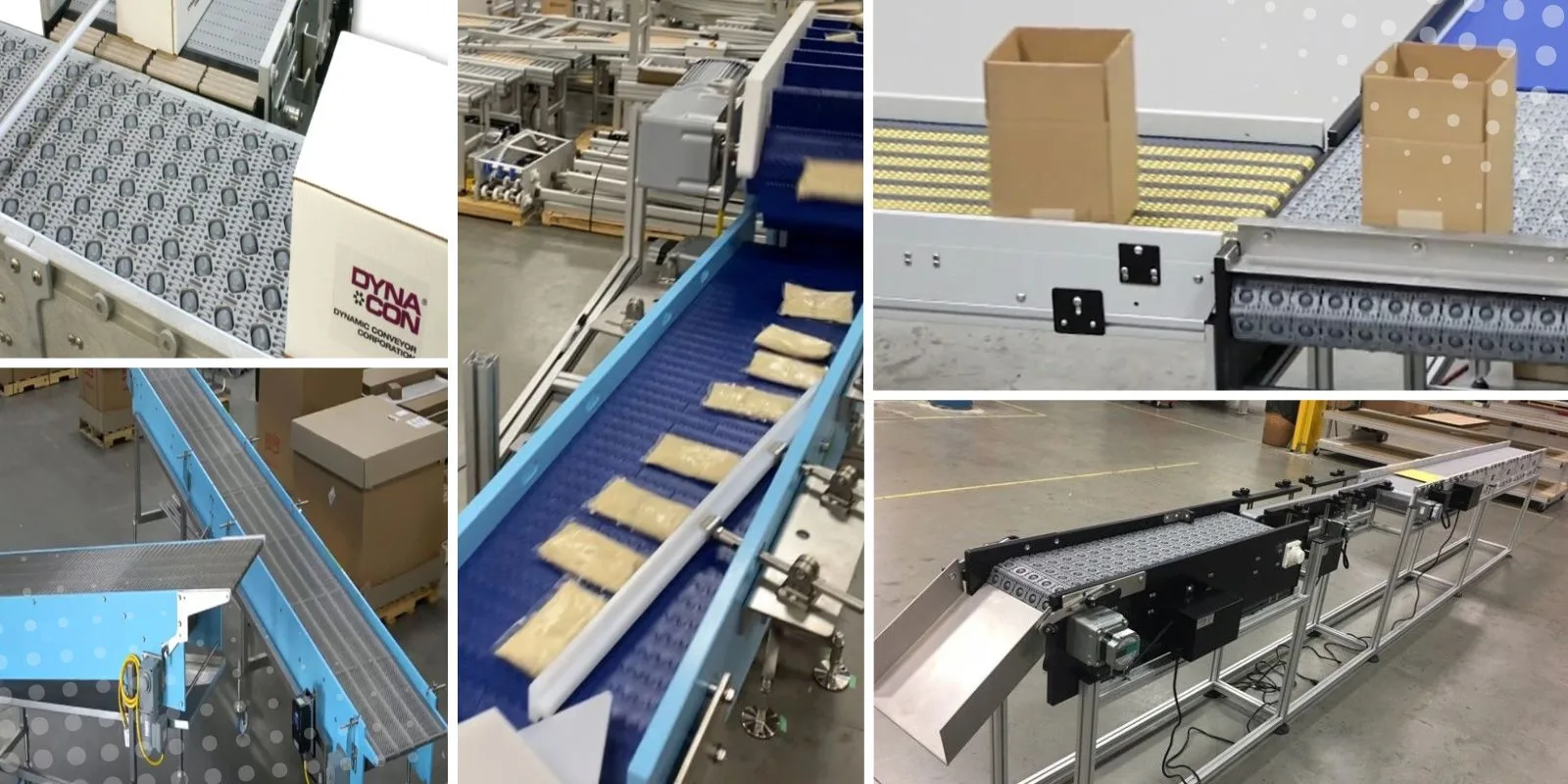
Moving products through a production line is only part of the challenge. Ensuring products transition smoothly between conveyors, machines, and processes is just as important.
Poorly designed transfer points can create bottlenecks, product damage, misalignment issues, and unnecessary downtime that impacts the efficiency of the entire operation.
Transfer conveyor systems are designed to create smooth, controlled transitions between different stages of production. Whether products need to change directions, merge into one line, move between elevations, or simply transfer from one conveyor to another, the right solution helps keep products moving while maintaining throughput and product quality.
Choosing the Right Transfer Method
No two applications are exactly alike, which is why transfer conveyors come in several different forms. The best option often depends on the product being conveyed, the production environment, and the overall goals of the system.

For small or delicate products, knife edge transfers help create a smooth handoff between conveyors by minimizing the transfer gap. This can help maintain product orientation while reducing the chance of products tipping, dropping, or becoming misaligned.

When multiple conveyor lines need to feed into a single process, inline merge transfers help organize product flow. By controlling how products enter the main line, these systems can reduce backups and improve throughput.

Waterfall transfers use gravity to move products from one level to another through a controlled drop. This simple approach is often used when reliable product movement and low maintenance are priorities.

For more stable products, dead plate transfers provide a stationary surface that bridges the gap between conveyors. They offer a straightforward solution for transferring consistent products between production stages.

When products need to change direction, ARB (Activated Roller Belt) right-angle transfers offer a highly controlled way to move items at 90-degree angles without traditional pushers or mechanical diverters. This makes them particularly useful for sorting, merging, and distribution applications.
More Than Just Moving Products
Transfer conveyors are often viewed as a small part of a larger conveyor system, but they can have a significant impact on overall line performance.
A properly designed transfer system can help:
- Reduce product damage during transitions
- Minimize jams and unplanned downtime
- Maintain product orientation and positioning
- Improve product flow between processes
- Support sorting, merging, and diverting applications
- Increase overall production efficiency
When transfer points are optimized, products move more predictably and operators spend less time addressing flow issues throughout the line.
Transfer Conveyor Applications Across Industries
Transfer conveyor systems are used across a wide range of industries because nearly every manufacturing or packaging operation depends on smooth product movement.
In food processing, transfer solutions help move products gently between production stages. Packaging operations often use merge transfers to bring multiple lines together before downstream equipment. Automotive manufacturers utilize transfers to move parts between conveyors and machinery, while consumer goods facilities frequently use right-angle transfers for sorting and distribution. Pharmaceutical applications also benefit from transfer systems that provide dependable movement between production processes.
Keeping Production Moving
The most effective conveyor systems do more than transport products. They help products arrive at the next stage of production in the right position, at the right time, and with minimal interruption to the process.
Whether it’s a knife edge transfer for delicate products, a merge system that combines multiple lines, or an ARB transfer that redirects products for sorting, the right transfer solution can make a noticeable difference in overall line performance.
At Dynamic Conveyor, transfer systems are engineered as part of the bigger picture. Every application has unique products, layouts, and production goals, which is why transfer solutions are designed around the specific needs of the operation. The result is smoother product flow, fewer interruptions, and a conveyor system that helps keep production moving from start to finish.