

Metal detection systems are used for identifying metal contaminants in the product flow.
Metal Detection Conveyor Solutions
Enhance Your Production Line with Dynamic Conveyor’s Metal Detection Solutions
In today’s fast-paced manufacturing environment, ensuring product purity and safety is paramount. Dynamic Conveyor’s metal detector conveyor systems are designed to seamlessly integrate into your production line, providing reliable and efficient detection of metal contaminants. Whether you’re in the manufacturing, food, pharmaceutical, or another industry, the inspection systems on our metal free conveyors offer unmatched performance and peace of mind.
Benefits of Metal Detection Conveyors
- Product Safety: Protect your consumers with automated product inspection equipment to ensure that your products are free from metal contaminants.
- Compliance: Meet industry regulations and standards with our reliable metal detection system.
- Cost Savings: Avoid costly recalls and damage to your brand reputation by detecting contaminants early in the production process.
- Efficiency: Maintain a smooth and efficient production line with our easy-to-integrate solutions.
Solutions Across Industries
- Plastics: Detects metal contaminants in plastic parts ensuring quality or protecting grinders from metal contamination
- Food Processing: Identifies metal in food products ensuring consumer safety
- Pharmaceuticals: Detects metal in pharmaceutical products, ensuring compliance
- Recycling: Identifies metal contaminants in recycled materials, improving quality and protecting processing equipment
- Textiles: Detects metal in textile products, preventing machinery damage
- Packaging: Maintain the purity of your packaging materials and prevent contamination
Learn more about metal free and metal detection conveyors in this blog.
Why Choose Dynamic Conveyor for Industrial Metal Detection?
Unparalleled Detection Accuracy – Our metal detection conveyors are equipped with state-of-the-art technology, designed to detect even the smallest metal particles, ensuring your products meet the highest quality standards.
Customizable Solutions – We understand that every production line is unique. That’s why our conveyors are fully customizable to fit your specific needs, from size and shape to detection sensitivity. Dynamic Conveyor offers both plate style and aperture style metal detectors and can tailor our inline metal detector solution to your specific application’s needs.
Seamless Integration – Designed for easy integration, our conveyors can be effortlessly added to your existing production line to create a metal free zone, minimizing downtime and optimizing automation.
Durable and Reliable – Built with high-quality materials, our conveyors are designed to withstand the rigors of continuous operation, providing long-lasting performance you can count on.
Expert Support and Service – At Dynamic Conveyor, we pride ourselves on offering exceptional customer service. Our team of experts is always ready to assist you with installation, maintenance, and any questions you may have.
Choose Dynamic Conveyor for your industrial metal detection needs and experience the difference in quality, reliability, and customer service. Contact us today to learn more about our conveyor belt metal detectors, reject mechanisms and other metal free conveyor solutions to see how we can help enhance your production line.


 9Nice job finding the conveyor solution that helps to detect metal! This solution offers reliable and efficient detection of metal contaminants. Now, head to the Industries page to find Success Stories, then find Amcor’s success story titled Eliminating Product Waste: Amcor’s Journey to Customer Conveyor Solutions for Plastics.


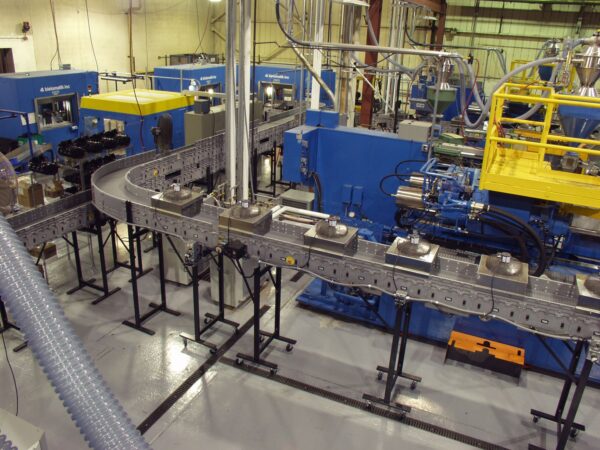
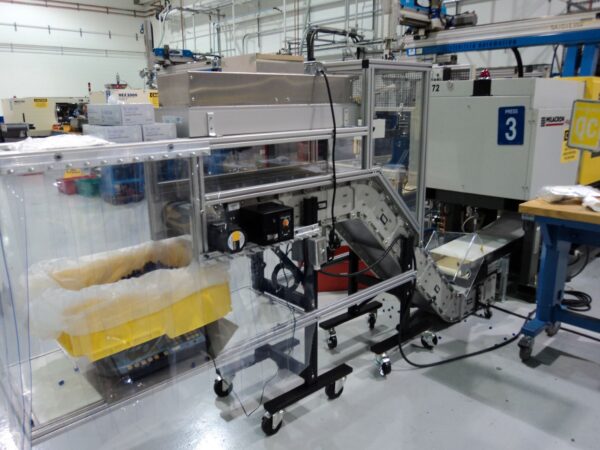

Watch these videos to see more of our conveyor solutions in action.

Solutions




Metal Detection FAQs
What is a "Metal-Free Zone" (MFZ) and why is it necessary on a conveyor?
A Metal-Free Zone is a designated section around the metal detector head where no metallic frame components, structural supports, or hardware can be present. Without this non-metallic buffer, the detector will trigger false positives due to electromagnetic interference from the conveyor itself. Because aperture dimensions, magnetic field sizes, and detector brands vary widely, a standard frame setup won’t suit every installation.
We engineer custom metal-free zones using specialized non-metallic conveyor belt and frame materials tailored to your specific detector head, and our sales team will help spec the exact clearance zone required for your line.
What types of automated reject mechanisms can be integrated into the conveyor?
Depending on line speed and product weight, industrial metal detection conveyors can be equipped with various reject methods—including Air Blast (for lightweight parts), Pushers or Diverter Arms (for heavier boxes or totes), Reversing Belts, Diverting Chute, or Stop-on-Detect controls. Because part geometries, line rates, and rejection tracking requirements are unique to each facility, off-the-shelf rejection setups often lead to misdirected rejects or jams.
Our sales team works directly with you to spec a custom rejection mechanism and lockable reject bin setup that matches your exact throughput speeds.
How do you prevent conveyor belts and belt splices from triggering false rejects?
Traditional belts with metal staples, carbon-heavy materials, or standard metal-reinforced splices will trip the metal detector as the belt cycles through the aperture. Metal detection conveyors require specialty modular plastic or Urethane solid surface belting, non-metallic hinge pins, or continuous plastic welds designed specifically for inspection applications.
Because belt tension, product weight, and chemical exposure vary by plant environment, we design custom, non-interfering belt systems, and our sales specialists will help spec the ideal belt material for zero false triggers.
Can your metal detection conveyors handle washdown and sanitary food processing environments?
Yes. For food, pharmaceutical, or wet manufacturing operations, conveyors can be built using FDA-compliant plastic components, stainless steel hardware outside the metal-free zone, and easy-clean modular frames designed for high-pressure washdowns. Because sanitation protocols (such as caustic chemical exposure or steam cleaning) differ across industries, a standard conveyor design may degrade prematurely.
Our team specializes in designing custom, easy-to-sanitize inspection conveyors, and our sales engineering team will help spec the precise washdown ratings your process demands.
Can you retrofit a conveyor to fit an existing metal detector head or line layout?
Absolutely. Whether you are integrating a new metal detector into an existing line or mounting a customer-supplied aperture head onto a new conveyor, system dimensions must align perfectly to prevent line bottlenecks or false triggers. Because floor space, line height, and control protocols are unique to every facility, off-the-shelf inspection conveyors rarely fit without expensive modifications.
Our sales team will analyze your existing line geometry and detector specifications to engineer a fully custom, drop-in conveyor solution.
What is the difference between an under-belt plate coil and a tunnel (aperture) coil metal detector?
An under-belt plate coil is a flat sensor mounted directly beneath the belt, so the belt rides over the coil and the detector scans up through the belt into the product. It is best suited for flat parts and shallow burden depths (typically under about 4 inches), such as sprues, runners, and loose hardware traveling to a granulator. Because sensitivity drops as the metal moves farther from the coil surface, it is not the right choice for tall products. Its main advantage is easy integration: it needs little to no metal-free zone and can often be retrofitted into an existing conveyor with minimal modification.
A tunnel coil surrounds the product with a balanced-coil aperture, delivering higher sensitivity to small ferrous, non-ferrous, and stainless steel contaminants in food, packaged, and bulk products. In exchange, the conveyor must be built around the detector: a metal-free zone of roughly 1.5 times the smaller aperture dimension for stationary metal and 2 times for moving metal, continuously welded frame members, electrically isolated pulleys and bearings, and a non-metallic slider bed that keeps the belt centered without touching the aperture.
Because product height, contaminant size, sensitivity targets, and available line length differ on every application, the right coil style depends on your process. We integrate both coil styles into our conveyors, and our sales team will help spec the detector type, metal-free zone, and belt construction that fit your line.